
Responses and Ordering
A response is one possible outcome for a mock API. It combines:
- a status code
- optional headers
- optional cookies
- a body
- an optional rule tree
- optional post-response actions
- a position in the execution order
The Response tab
The Response tab controls what the caller receives.
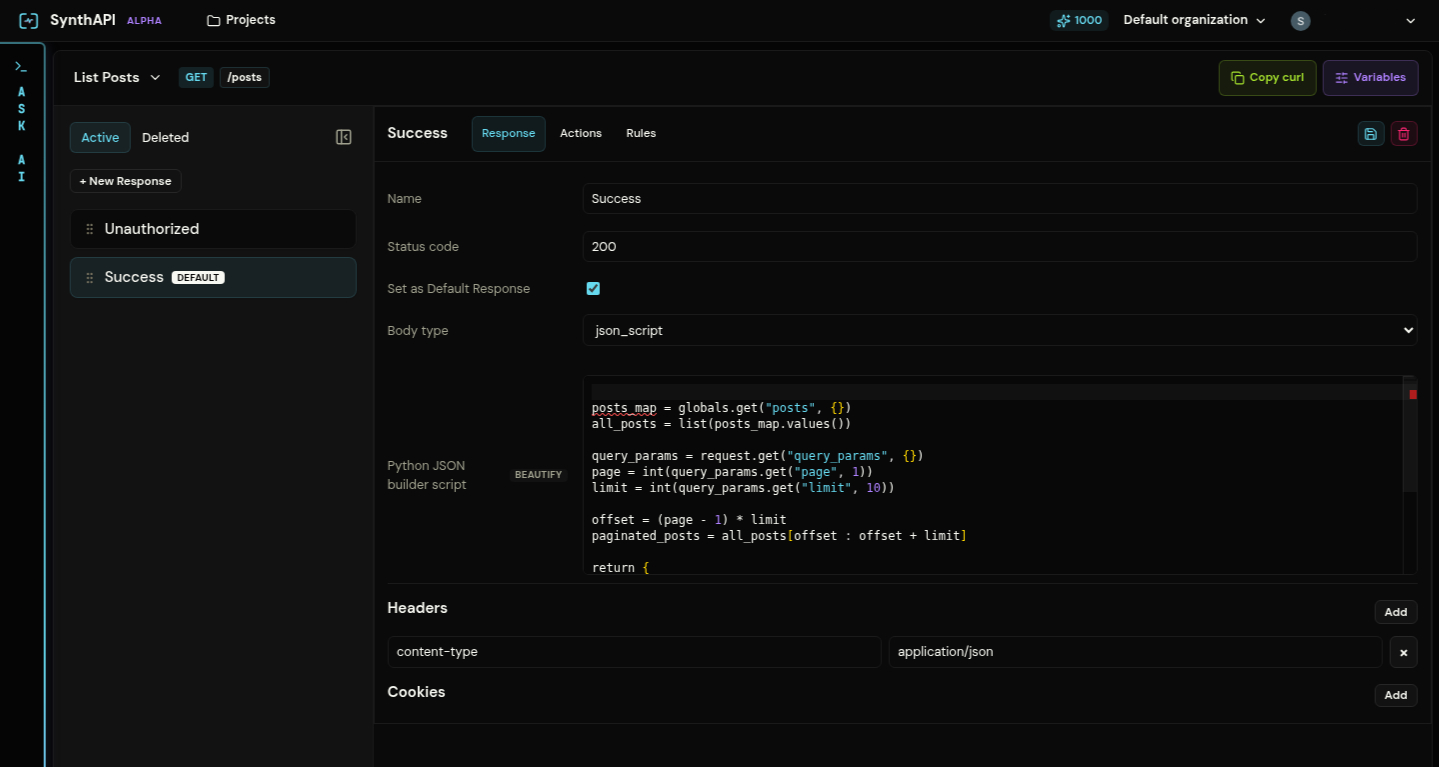
From this screen you can set:
- the response name
- the status code
- whether it is the default response
- the body type
- headers and cookies
Supported body types
The platform currently supports these response body modes:
json: static JSONjson_script: Python that returns JSON at request timetext: plain text bodyempty: no bodysse: Server-Sent Events, either as discrete events or a script
The seeded List Posts example uses json_script to paginate the posts global from query parameters.
What each response usually means
The seeded examples use a small set of response roles repeatedly:
| Response name | Typical role |
|---|---|
Unauthorized | Reject the request before any main logic runs |
Invalid Request Body / Invalid Parameters | Reject malformed or unsupported input |
Not Found | Reject a request for missing state |
Success / Post Created / Text generation stream | The main happy-path result |
These names are not hard-coded by the platform, but they are a useful pattern because they map cleanly to ordered branching.
How ordering works
Responses are evaluated from top to bottom. As soon as one response matches, the runtime stops and serves it.
That means the order itself is part of the behavior:
- Specific failures should go first
- Broader validation failures should go next
- The default success case should usually go last
For example, the seeded Create Post flow is ordered as:
UnauthorizedInvalid Request BodyPost Createdas the default
The seeded Streaming Chat Completions flow is ordered as:
UnauthorizedInvalid ParametersText generation streamas the default
This keeps error branches narrow and predictable while leaving the final default response as the fallback.
Default responses
The default flag does not make a response run first. It marks the fallback response that should be used when no earlier conditional response matches.
In practice:
- keep only one default response per API
- put it after your conditional branches
- treat it as the main success path unless you have a deliberate reason not to
The Blog CRUD API walkthrough and LLM SSE Events walkthrough both follow this pattern.